
India's waste. India's energy. India's soil.
We convert crop and agro-industrial residue into BioCNG and organic fertiliser, engineered for smallholder agriculture: the feedstock reality of most of the world's farmland.



Four problems that are really one.
Crop residue is burnt in the field because clearing it costs money the farmer does not have at that moment. Burning is not carelessness. It is arithmetic.
Cities and food processors pay to send organic waste to landfill, where it decomposes and releases methane, a gas with roughly 28 times the warming effect of carbon dioxide.
India buys close to half the natural gas it consumes from abroad. Most economies with large smallholder farming sectors are in the same position.
Soil organic carbon across much of the world's cropland has fallen below the level at which soil holds water through a dry spell.
These are treated as four problems. They are one, and it has one answer.
Waste in. Fuel and soil out.
| Stream | Input | Output |
|---|---|---|
| Sugar industry waste | Press mud, bagasse fines and spent wash from mills and distilleries | BioCNG + potash-rich organic fertiliser |
| Energy biomass | Napier grass and dedicated energy crops grown in the catchment | BioCNG + solid and liquid fertiliser |
| Agri & organic biomass | Crop residue, market and food-processing organic waste | BioCNG + certified organic fertiliser |
Built for the way most of the world farms.
Commercial biogas technology was developed for consolidated hundred-hectare farms: maize silage, cattle slurry, temperate storage, feed-in tariffs. Most of the world farms differently: residue arrives fragmented across one- and two-hectare holdings, in sharp seasonal windows, with high fibre and high silica. India is the largest and hardest version of that reality, which makes it the right place to prove the answer.
The farmer is both our supplier and our customer.
He sells us his residue; he buys back the fertiliser. Farmer welfare is the operating logic of the business itself; value returns to the catchment it came from.
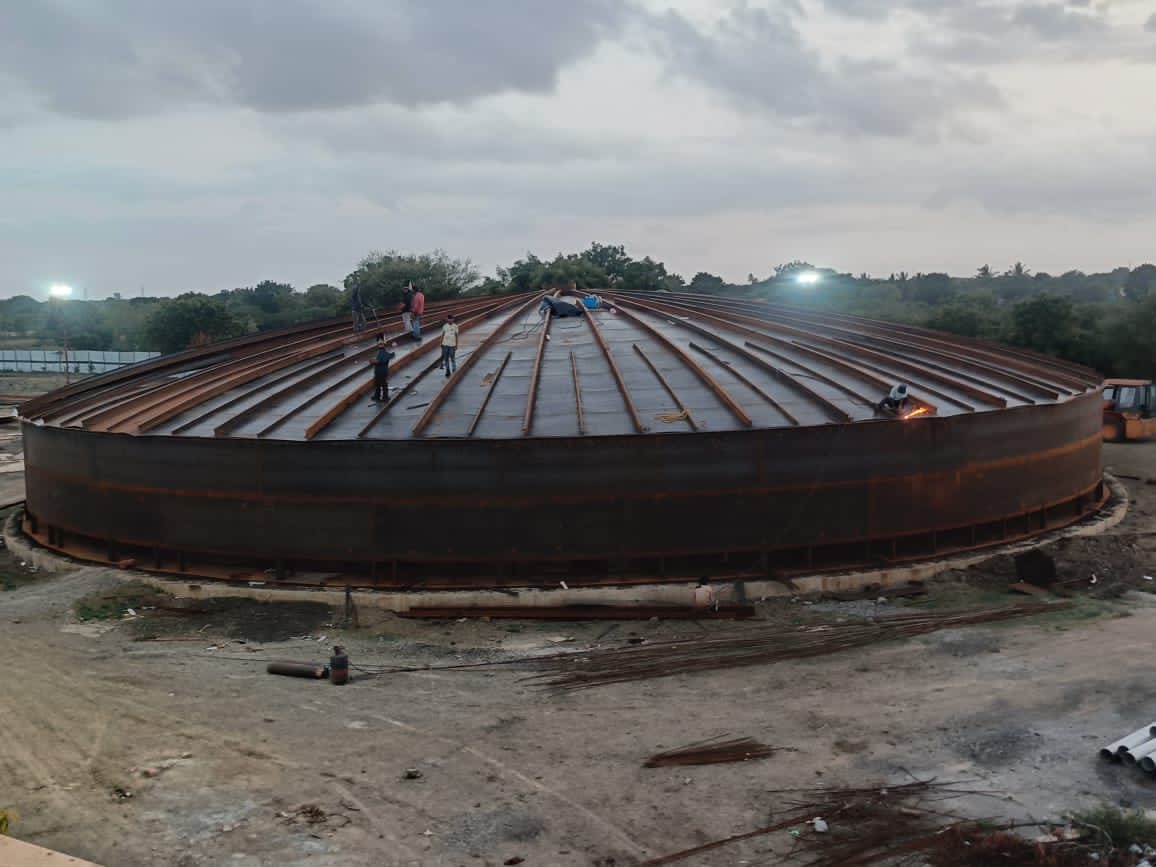
A 10 TPD research plant, built to be studied.
Multifeed waste and biomass in, clean fuel and organic fertiliser out. Every batch is characterised, digested and tested, so the recipes and microbial cultures proven here carry into commercial-scale parks. Under construction, scheduled to commission on 1 March 2027.
| Capacity | 10 TPD BioCNG output |
|---|---|
| Feedstock | Multifeed: waste + biomass |
| Purpose | Feedstock & microbiology research, lab to commercial scale |
| Process | CSTR anaerobic digestion |
| Purification | Water scrubber to SATAT purity |
| H₂S removal | Two-stage: water + chemical scrubbing |
| Outputs | BioCNG · solid & liquid organic fertiliser |
| Commissioning | Scheduled 1 March 2027 |
One plant, or the whole park.
Impact measured, method attached.
The chain runs Farmer → Clean energy → Employment → Soil → Organic food, and totals in Lives and Environment. Every figure carries its method; ledger figures publish with first-cycle reporting and stay visibly marked until then.
तुमच्या शेतातील पिकांचे अवशेष आम्ही विकत घेतो. सेंद्रिय खत शेतात परत येते.
We buy your crop residue. Organic fertiliser returns to your field.
Build with us.
For sugar mills, distilleries, municipalities, developers and investors: the plant, the park, or the partnership.